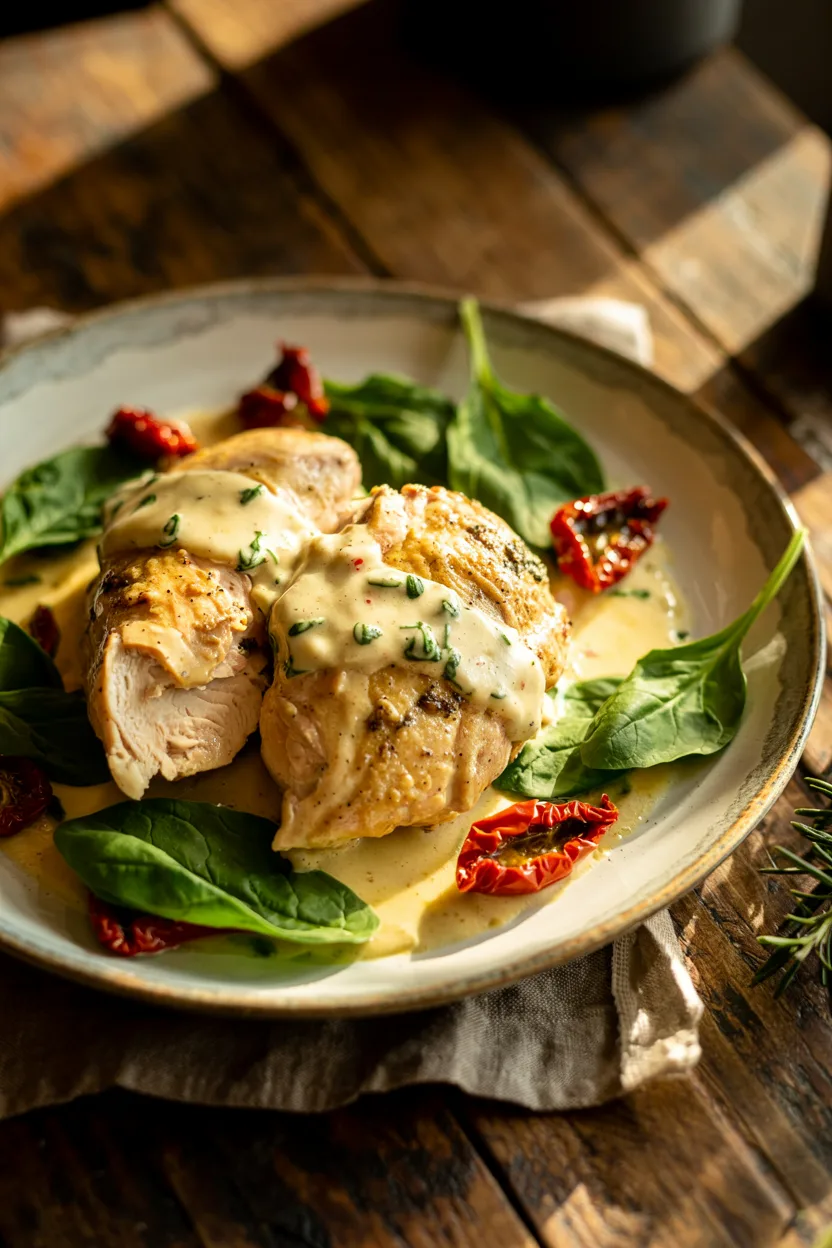
Creamy Tuscan Chicken
Two chicken breasts cut into four thin cutlets, seared and finished in a garlic and Parmesan cream sauce with baby spinach and sun-dried tomatoes. One skillet, 35 minutes, serves 2, with every quantity measured and the nutrition computed from them.
Equipment
- 12-inch skillet a 10-inch works, but you will sear in two batches and add about 5 minutes
- Instant-read thermometer not optional in this recipe
- Meat mallet or heavy pan for pounding the cutlets to an even 1/2 inch
Ingredients
- 2 boneless skinless chicken breasts About 8 oz (227 g) each, 1 lb / 454 g total, which is the weight the nutrition figures are computed on (raw, standard recipe-card practice). Halve each one horizontally to make 4 thin cutlets and pound the thick shoulder end to an even 1/2 inch.
- 1/2 teaspoon fine sea salt 3 g, divided. This is the weight the 992 mg sodium figure is built on. Half seasons the raw cutlets, half finishes the sauce after the Parmesan. If you use kosher salt, weigh out 3 g rather than measuring by spoon: brands differ by up to 70 percent per teaspoon, which is enough to move the published sodium figure by more than 10 percent in either direction. Parmesan and sun-dried tomatoes are already salty, so this is deliberately restrained.
- 1/2 teaspoon freshly ground black pepper Divided. Half on the cutlets, half in the finished sauce.
- 2 tablespoons olive oil 27 g. For searing the cutlets.
- 1 tablespoon unsalted butter 14.2 g. Goes in with the sun-dried tomatoes to build the sauce base, not at the end. Use unsalted: salted butter adds roughly 90 mg of sodium to the batch, about 45 mg a serving, and the published figure assumes unsalted.
- 1/3 cup oil-packed sun-dried tomatoes 37 g, drained and julienned. Oil-packed and drained, not dry-packed; the two are not interchangeable by volume and dry-packed needs rehydrating first. Read the jar label and choose one packed in plain oil, herbs and vinegar, since some marinades include alcohol-based ingredients.
- 3 cloves garlic Minced, about 1 tablespoon / 9 g. Cooked in the fat for 30 to 60 seconds before any liquid enters the pan.
- 1 teaspoon dried oregano Bloomed in the fat with the garlic. Its flavour compounds are fat-soluble, so stirring it into finished cream leaves it dusty and floating on top. Italian seasoning is an even swap.
- 1/4 cup low-sodium chicken broth 60 ml. Deglazes the pan and lifts the fond; it is the only liquid this recipe uses for that job. Broth sodium varies enormously by brand, and the nutrition figure assumes low-sodium (about 70 mg per 1/4 cup); an ordinary canned broth pushes a serving to roughly 1,065 mg. Check the ingredient statement and pick a plain broth, as some stocks and concentrates carry alcohol-based flavourings.
- 3/4 cup heavy cream 180 ml / 178 g. Must be heavy or heavy whipping cream at 36 percent fat or above. Half-and-half, light cream and milk have too little fat to protect the milk proteins and will curdle against the acid in the sun-dried tomatoes.
- 2 cups fresh baby spinach Loosely packed, 60 g. Loosely packed, not packed down: two genuinely packed cups is closer to 120 g, which would put twice as much water into the sauce. Added raw straight into the simmering sauce; never wilted in a separate pan.
- 1/3 cup Parmesan Freshly grated, 33 g. Weigh it if you can: 1/3 cup is 33 g grated on the fine side of a box grater; a Microplane produces a much fluffier grate, so measure a scant 1/2 cup to reach the same 33 g. Grate it yourself from a refrigerated wedge: shelf-stable pre-grated shaker Parmesan contains anti-caking agents, will not melt smoothly, and carries enough extra sodium to push a serving to about 1,070 mg.
Instructions
- Pat the chicken breasts completely dry. Lay each one flat and slice it horizontally all the way through to make two thin cutlets, four cutlets in total. Each cutlet tapers, so lay them between two sheets of plastic wrap and give the thick shoulder end a few light taps with a mallet or the flat of a heavy pan until the whole cutlet is an even 1/2 inch. Season both sides with 1/4 teaspoon of the salt and 1/4 teaspoon of the pepper, and set them aside while you prep everything else.
- Do the rest of your prep now, because once the pan is hot nothing waits. Grate the Parmesan finely and weigh out 33 g if you have a scale. Drain the sun-dried tomatoes and cut them into thin strips, mince the garlic, wash the spinach and dry it thoroughly (wet leaves water down the sauce), and measure the cream and the broth into separate cups. Put an instant-read thermometer where you can reach it: two steps below depend on it.
- Heat the olive oil in a 12-inch skillet over medium-high until it shimmers, about 2 minutes.
- Lay the cutlets in the pan in a single layer with a little space between them and leave them alone for 3 minutes, until the underside is deep golden. If they are touching, sear in two batches instead: crowded cutlets steam rather than brown. Flip and cook 2 to 3 minutes more, to 155-160°F (68-71°C) at the thickest point. Move them to a plate and tent loosely with foil; they finish cooking later, in the sauce. In a 10-inch pan, plan on two batches from the start and add about 5 minutes to the cook time.
- Turn the heat down to medium. Add the butter and the sun-dried tomatoes and cook, stirring, for about 1 minute, until the butter has melted and the fat has taken on the red colour of the tomatoes.
- Add the minced garlic and the dried oregano to the fat. Cook, stirring constantly, for just 30 to 60 seconds, until fragrant and the garlic is barely pale gold. This is the only moment in the recipe when either one gets cooked properly: garlic dropped into a finished cream sauce stays sharp and sulfurous, and dried oregano stirred into cream never dissolves. Do not let the garlic take on real colour or it turns bitter.
- Pour in the chicken broth and scrape the bottom of the pan with a wooden spoon to lift every browned bit. Let it bubble 30 to 45 seconds, until the pan bottom is clean and the broth has cooked down to a thin film. Do not wait for it to visibly reduce by half; a quarter cup spread across a 12-inch pan is a wet smear with no depth to judge, and leaving it longer only scorches the fond you just lifted.
- Turn the heat down to medium-low, or low if you have a strong burner. Pour in the cream and bring it to a bare simmer: small lazy bubbles at the very edge of the pan, never a rolling boil. Cook until the sauce thickly coats the back of a spoon and holds a clean line when you draw a finger through it, usually 1 to 2 minutes in a 12-inch skillet and 3 to 4 in a 10-inch. Go by the spoon, not the clock. Cream spread thin over a wide pan reduces fast, and pushing it past this point leaves it greasy and prone to splitting.
- Keep the heat at medium-low and add the spinach in two handfuls, stirring the first one in until it collapses before the second goes in. Cook 1 to 2 minutes, until every leaf has wilted into the sauce. Two cups of spinach carry roughly a quarter cup of water, so the sauce will thin noticeably; that is normal. Simmer 1 to 2 minutes more, until it coats the spoon again. Fix a thin sauce here, before the cheese goes in, because you cannot simmer it down afterwards.
- Turn the heat down to low. Return the cutlets to the pan along with every drop of juice that collected on the plate, spoon the sauce over them and warm through for 2 to 4 minutes, until the thickest cutlet registers 165°F (74°C), the USDA safe minimum for poultry. Do not let the sauce boil. Colour and clear juices are not reliable; use the thermometer. If it has not reached 165°F, cover the pan and give it another minute rather than turning the heat up.
- Take the pan off the burner and switch the heat off. Wait 30 seconds; a heavy skillet holds enough residual heat to break the cheese even with the burner off. Now whisk in the Parmesan a small handful at a time, letting each addition melt smoothly before the next goes in. Season with the remaining 1/4 teaspoon salt and 1/4 teaspoon pepper, and taste. Salt goes in here, after the cheese, not before it. If the sauce has tightened too much, loosen it with a tablespoon of warm broth or cream.
- Serve straight from the skillet, spooning the spinach and sauce over each portion.
Notes
What you need on the counter. A 12-inch skillet (a 10-inch works, but you will sear in two batches and add about 5 minutes), an instant-read thermometer, and a meat mallet or a heavy pan for pounding the cutlets. The thermometer is not optional here: the chicken comes out of the pan deliberately under-done at 155-160°F and finishes in the sauce at 165°F, and there is no colour or juice cue that tells you reliably when that has happened.
Why a cream and Parmesan sauce splits, and how to stop it. Four things break this sauce: boiling it once the cream is in (dairy proteins seize above about 180°F), over-reducing it until there is no longer enough water to hold the fat in suspension, adding the Parmesan while the pan is still hot, and the acid in the sun-dried tomatoes. Your protection is heavy cream at 36 percent fat or higher, whose fat coats the proteins and keeps them from binding. That is why the burner goes to medium-low before the cream and stays there, why the spoon rather than the clock decides when the sauce is reduced, why the chicken is brought up to temperature before the cheese goes in rather than after, and why the pan comes off the heat for a full 30 seconds before the first handful of Parmesan. If it does break anyway, whisk in about 1/4 cup of water and bring it back to a brisk simmer; it will usually come back together.
Make-ahead and storage. Everything in the prep step can be done a day ahead: cutlets sliced, pounded and seasoned in the fridge, Parmesan grated, tomatoes sliced, garlic minced, spinach washed and dried. The sauce itself does not make ahead well. Leftovers keep in an airtight container in the fridge for up to 3 days. Reheat gently in a skillet over low heat with a splash of cream or broth, stirring; a microwave will boil the sauce and separate it. Do not freeze, as cream sauces break on thawing.
Substitutions that actually work. Pecorino Romano or aged Asiago can stand in for the Parmesan, but both are considerably saltier, so halve the finishing salt, taste before adding more, and treat the published sodium figure as no longer applying. Chicken broth is the only liquid this recipe uses, and a small squeeze of fresh lemon stirred in off the heat at the very end gives the sauce all the brightness it needs. Out of sun-dried tomatoes, 2 tablespoons of sun-dried tomato paste stirred in with the cream gets you close, though you lose the chew. Italian seasoning swaps evenly for the dried oregano.
A lighter version, and everything it costs you. Swapping the 3/4 cup of heavy cream for the same volume of evaporated whole milk brings a serving to roughly 695 calories and about 40 g of fat, down from 870 and 65.1 g. It is lower in calories only: the same swap pushes sodium to roughly 1,068 mg and total carbohydrate to about 18 g a serving (about 16 g net, up from 8.9), so do not treat it as the low-carb version. These are estimates from the swap, not measured values. Be warned, too, that lower-fat dairy has far less fat protecting the milk proteins, so it is much likelier to curdle against the acid in the sun-dried tomatoes: keep it well below a simmer and add the Parmesan off the heat without exception. Half-and-half, light cream and plain milk do not have enough fat for this sauce at all and will split. Do not use them.
Nutrition per serving (recipe makes 2). Calories 870 · Total Fat 65.1 g (83% DV) · Saturated Fat 30.6 g (153% DV) · Cholesterol 296 mg (99% DV) · Sodium 992 mg (43% DV) · Total Carbohydrates 11.1 g (4% DV) · Fiber 2.2 g (8% DV) · Net Carbs 8.9 g · Protein 61.1 g (122% DV). Calculated from the quantities in this card using USDA food data and current FDA Daily Values; chicken is costed raw, which is standard recipe-card practice. The sodium figure assumes unsalted butter, low-sodium broth and freshly grated Parmesan from a refrigerated wedge.