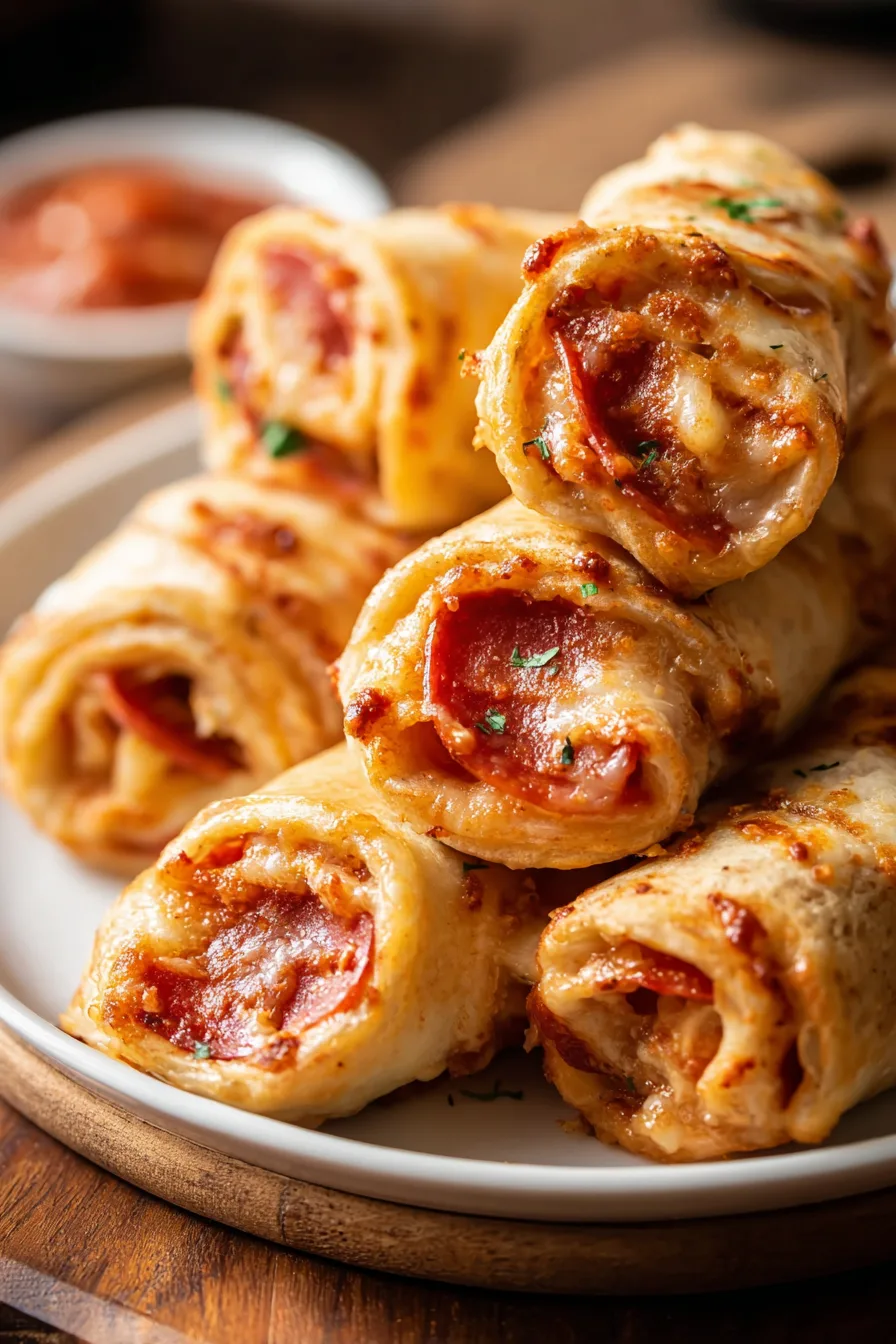
Easy Turkey Pepperoni Pizza Roll-Ups Recipe | 36 Minutes
- Total time
- 36 minutes
- Makes
- 4 roll-ups
- Net carbs
- 6.9g
- Calories
- 297
When I first started making turkey pepperoni pizza roll-ups, I spent an embarrassing number of batches watching them melt into puddles on the baking sheet. The fix turned out to be simple, and it is now the whole recipe: bake the mozzarella into thin sheets first, let them cool for two or three minutes until they bend like leather, and then spread the cream cheese filling and roll. They still deliver everything I love about pizza – melted cheese, savory turkey pepperoni, oregano and garlic – but with no dough, no tortilla, and no rising time.
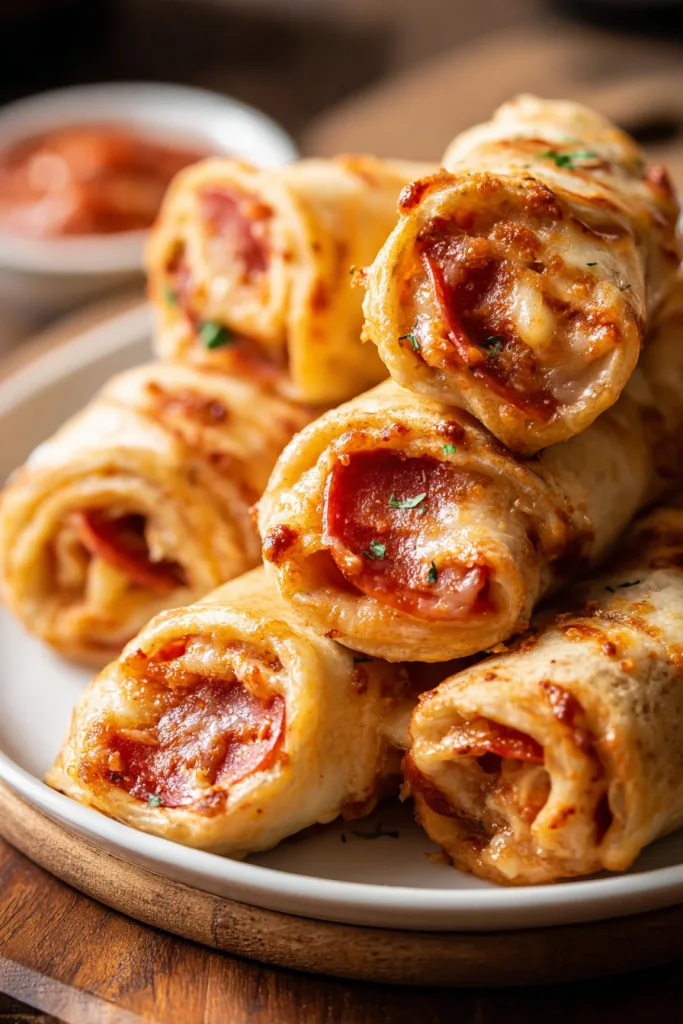
What makes these turkey pepperoni pizza roll-ups worth the technique is how versatile they are once you have it down. I have served them as appetizers at dinner parties, packed them for lunch, and made them as a quick weeknight dinner when I wanted something both comforting and genuinely low in carbs. The whole thing comes together in a little over half an hour, and the only thing that ever goes in the oven is plain shredded cheese.
Here is the part I got wrong for years, and it is worth understanding before you start. A soft slab of cream cheese and raw shredded mozzarella has nothing holding it together – no egg to set, no flour to absorb the water – so at 375°F it simply relaxes and spreads. Baking the mozzarella on its own is what fixes that: the sheet sheds a good chunk of its moisture in the oven, and as it cools the fat firms back up into something you can genuinely wrap around a filling. If you would rather build your pizza on a real dough, I have a separate keto pizza recipe made with fathead dough – but this one keeps the ingredient list short and skips the almond flour and egg entirely.
Recipe Timing
Prep Time: 22 minutes | Cook Time: 14 minutes | Total Time: 36 minutes
Servings: 4 (1 roll-up each) | Difficulty: Easy
Ingredients Table
| Ingredient | Quantity | Notes |
|---|---|---|
| Low-moisture mozzarella, shredded | 2 cups (8 oz / 226 g), divided | 1 3/4 cups bakes into the four shells; 1/4 cup goes into the filling. It must be low-moisture – fresh mozzarella packed in water weeps and will never set into a sheet. |
| Cream cheese, full-fat | 4 oz, softened | From a block, at true room temperature. Cold cream cheese will not beat smooth, and this is the glue that seals the roll. |
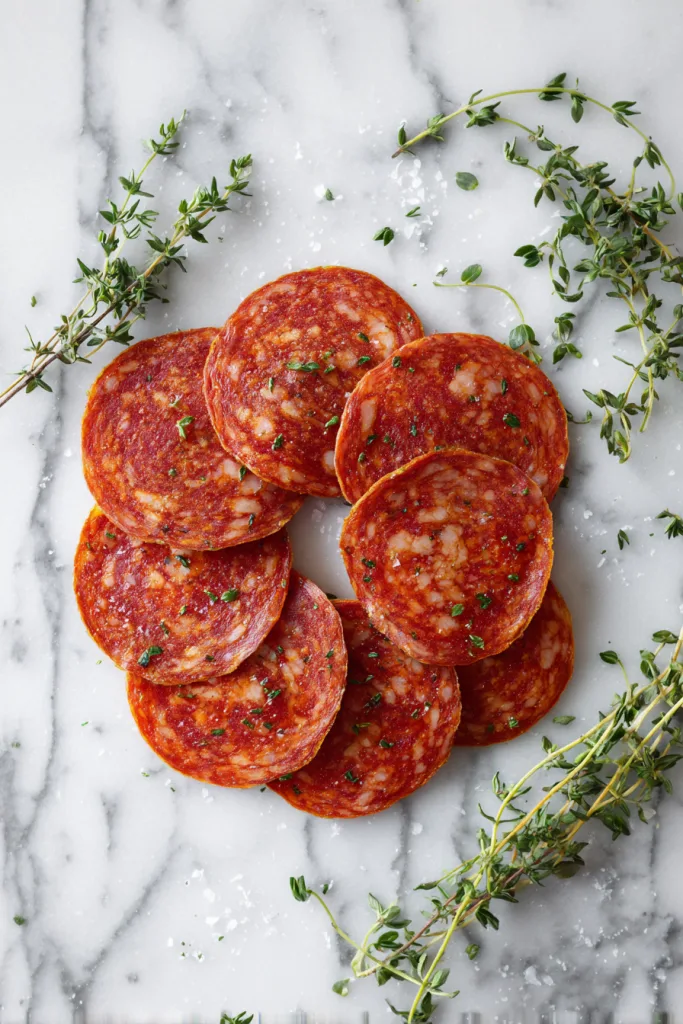
| Turkey pepperoni, halal-certified | 8 slices | 2 per roll-up. Thin deli slices roll far more neatly inside a thin cheese shell than thick-cut ones. |
| Marinara sauce | 1/2 cup, divided | 2 tablespoons beaten into the filling; 6 tablespoons warmed for dipping. Check the label and choose one made without wine. |
| Dried oregano | 1 teaspoon, divided | 1/2 teaspoon in the filling, 1/2 teaspoon over the cheese before it bakes. Crush it between your fingers first. |
| Garlic powder | 1 teaspoon | Powder, not fresh minced garlic – fresh garlic adds water and loosens the filling. |
| Fresh basil, finely chopped | 1 tablespoon | Goes into the filling, where it stays raw and green because nothing is re-baked. |
| Freshly ground black pepper | 1/4 teaspoon | Into the filling. |
| Salt | 1 pinch, or to taste | Taste the filling first. The cheeses and turkey pepperoni are already salty enough that I usually skip it. |
| Fresh parsley, chopped | 1 tablespoon | Scattered over the finished roll-ups just before serving. |
The list is short, but two items are doing real structural work and neither is negotiable. The mozzarella has to be low-moisture and shredded, because it is the structure of this dish – that is also why there is twice as much of it as you might expect. And the cream cheese has to be properly softened, because it is the adhesive: it welds the seam of the roll shut, exactly the way it does in a tortilla pinwheel. Cold, lumpy cream cheese will not grip the shell, and the roll will spring open.
Pro tip on the marinara, and this one matters more than it used to. Six of the eight tablespoons are warmed and served straight as a dipping sauce rather than cooked into anything, so read the jar before you buy it: plenty of tomato and tomato-basil sauces are made with wine. Pick one without. If you can also find a no-sugar-added marinara, it meaningfully lowers the net carbs. Taste it too – some store-bought sauces are salty enough that you will not want to add any salt to the filling at all.
Step-by-Step Instructions
Read the whole method through once before you start. The single thing that decides whether these work is a two- to three-minute window after the shells come out of the oven, and you do not want to be hunting for the parsley while it closes.
Step 1: Heat the Oven and Set Up
Heat the oven to 375°F (190°C) with a rack in the middle. Line an 18×13-inch half sheet pan with parchment paper – parchment, never wax paper. Then tear off a second sheet of parchment and lay it on the counter as your assembly surface. I keep a small offset spatula next to it, because spreading a thin, even layer with the back of a spoon is more work than it needs to be.
Step 2: Make the Filling
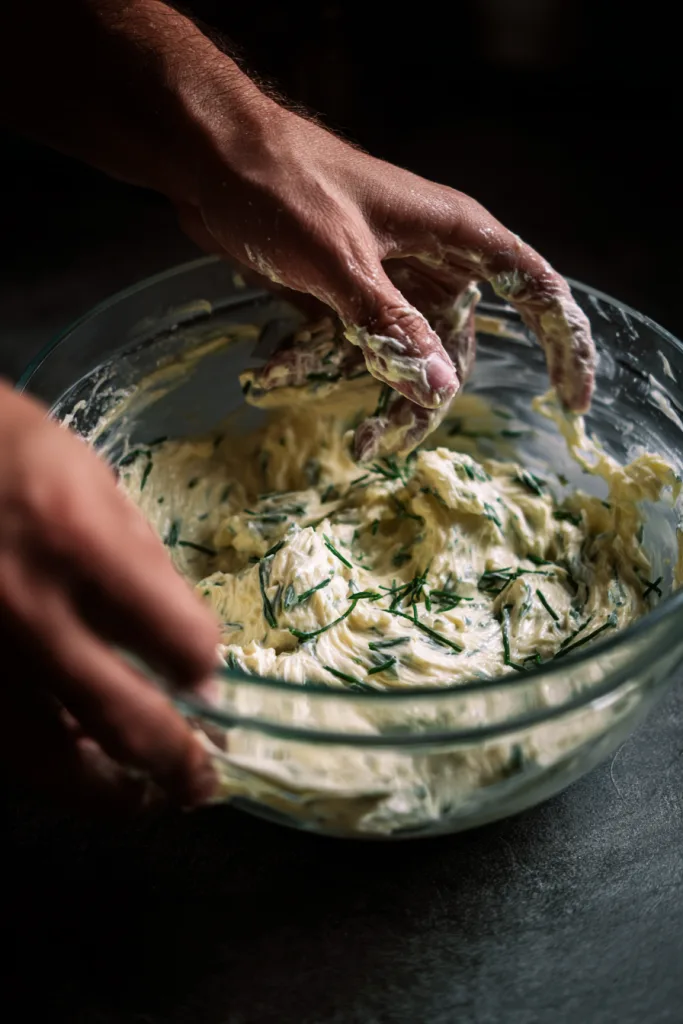
In a medium bowl, beat the softened cream cheese with 2 tablespoons of the marinara, 1/2 teaspoon of the oregano, all of the garlic powder and the black pepper until it is completely smooth and no orange streaks are left. You want that sauce emulsified into the cheese rather than sitting on top of it – that is what keeps free liquid out of the roll later. Fold in 1/4 cup of the shredded mozzarella and the chopped basil.
Taste it now, then add a pinch of salt only if it needs one. Between them, the mozzarella and the turkey pepperoni already bring about 461 mg of sodium to each roll-up, so I almost always skip the salt entirely. You should end up with about 1 cup of filling.
Step 3: Portion Everything Before the Shells Go In
This is the step I used to skip, and skipping it is exactly why my third and fourth roll-ups always cracked. Divide the filling into 4 equal mounds on a plate – a scant 1/4 cup, about 3 3/4 tablespoons each. Separate the 8 turkey pepperoni slices into 4 pairs. Chop the parsley. Set the plate down next to your sheet of counter parchment so everything is within arm’s reach.
Step 4: Shape and Bake the Mozzarella Shells
Divide the remaining 1 3/4 cups of shredded mozzarella into 4 equal mounds of 7 tablespoons – a scant 1/2 cup each – on the lined pan, arranged two by two with at least 2 inches between them. Spread each mound into an even rectangle about 5 x 3 inches. That is deliberately smaller than you want the finished shell to be, because they spread as they melt and come out at roughly 6 x 4 inches.
Keep each rectangle an unbroken single layer with no bare patches – any gap you leave now becomes a tear when you roll. Sprinkle the remaining 1/2 teaspoon of oregano evenly over the four of them.
Bake at 375°F for 12 to 14 minutes, and start checking at 10. Let the cue below decide rather than the clock. An underbaked sheet never sets, and that is the likeliest reason these fail. At 7 tablespoons of cheese each, these sheets are considerably heavier than the thin rounds most cheese-shell recipes bake, and a heavier sheet needs longer to shed its water. Eight minutes leaves them wet in the middle, and a wet sheet never sets.
Let the cue decide, not the clock. The sheet melts, then boils hard right across its surface, and then that boil dies away – and the dying is the signal. They are ready when the bubbling in the center has stopped: the edges may still simmer faintly, but the middle should look still, matte and lacy with tiny pinholes rather than wet and glossy, and the edge should be a continuous deep gold the whole way round. Do not wait for the center to brown. A sheet browned in the middle has gone past pliable and will snap instead of bending, which is the one failure a full 360-degree wrap cannot survive.
While they bake, warm the remaining 6 tablespoons of marinara for dipping – 30 to 40 seconds in the microwave, or a minute in a small pan.
Step 5: Cool on the Pan to the Pliable Window, Then Fill and Roll
Leave the sheets exactly where they are, on the hot pan. This is the step that makes the whole recipe work, and the pan is part of it: it goes on driving moisture out of the underside for another minute or two, and it holds the cheese warm so the pliable window stays open. Slide the parchment onto a cold counter and the sheets chill from both sides instead, which can take one from floppy to brittle in under a minute.
Blot the pooled oil off the top with a paper towel first – a 7-tablespoon sheet renders a lot of it, and oil left sitting there stops the seam gripping – then rest them 2 minutes, 3 at the outside. Test one before you commit: push the edge with a thin spatula. It should slide across the parchment as a single piece, and the lifted edge should hold a curve without flopping or snapping. It feels like warm leather. If it stretches like the cheese on a hot pizza slice, or leaves a greasy film glued to the paper, it is underbaked – every sheet is underbaked together at this stage, so put the whole pan back in for 1 to 2 more minutes. If it clicks against the paper or cracks as you lift it, it has cooled too far.
Work through them one at a time, and expect the third or fourth to stiffen while you are still filling the first two. That is normal, not a mistake. When one does, re-soften that single shell and nothing else: slide a thin spatula under it, lift it onto a square of parchment or foil set on a second pan, and give it 30 seconds in the oven on its own. Do not put the whole sheet pan back in. The shells you have not got to yet are still inside their window, and a second blast of heat would only re-melt the ones that were perfectly fine.
Spread one portion of filling over each shell in an even layer a scant 1/4 inch (about 5 mm) thick, taking it right out to within 1/4 inch of both long edges but leaving 1/2 inch bare at each short end. The filling is what seals this roll, so do not leave a wide bare strip along the edge you are rolling toward. The bare half inch at each end is there for the opposite reason: it gives the filling somewhere to go when you close the roll instead of squeezing out the sides. Lay 2 slices of turkey pepperoni end to end over the filling along the near long edge.
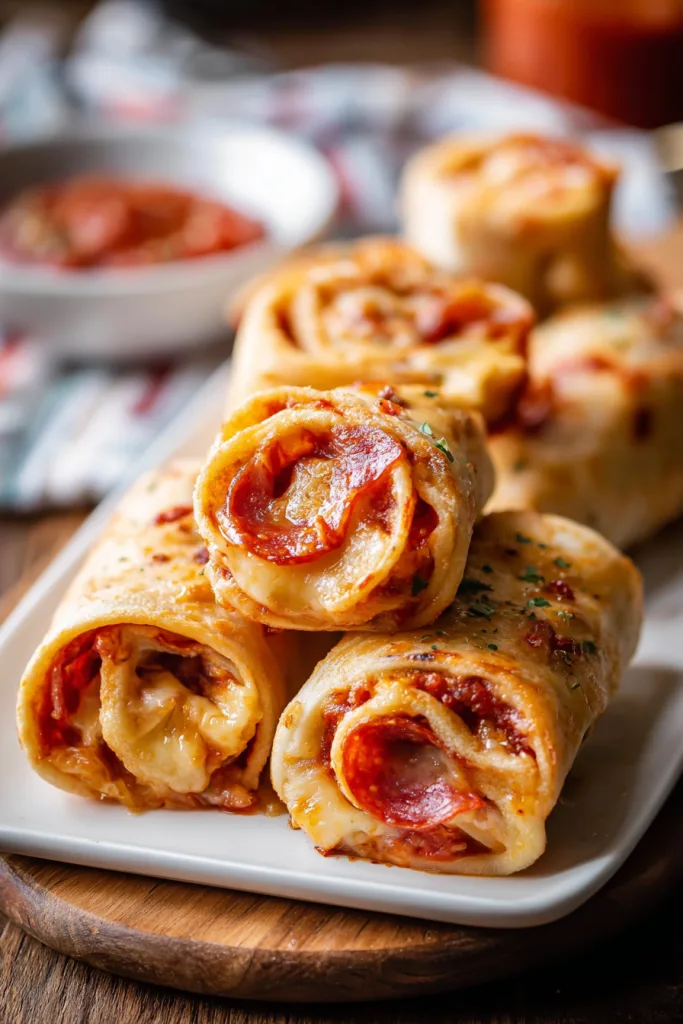
Starting from the turkey pepperoni edge, roll the shell away from you into a snug cylinder – snug enough that there is no hollow down the middle, but do not squeeze or compress it or you will push filling out of both ends. Use the parchment underneath to lift and guide the roll while keeping the paper itself out of it. Finish with the seam underneath. Repeat with the remaining three shells to make 4 roll-ups total.
Step 6: Rest, Garnish and Serve
Leave the roll-ups seam-side down for 3 minutes after the last one is rolled – the first ones will have had longer. They are ready when the outside feels firm and dry rather than greasy, and the seam stays shut when you lift one.
Do not return the filled roll-ups to the oven. The shells are already baked, and a second bake would only soften the cream cheese and let it run out the ends. Scatter the chopped parsley over the top and serve them warm and whole, with the warmed marinara alongside for dipping.
One honest note about temperature: these are warm rather than hot. The shell still carries oven heat and the filling is at room temperature, and that is as hot as this method can safely get. Do not try to slice them at this stage either – for a pinwheel platter, see the chilling note under Serving Suggestions.
Pro Tips for Perfect Results
Through a lot of failed batches I have landed on a handful of things that make the difference. The first is that a shell which snaps as you roll it has simply been left too long – lift that one shell onto a second pan and give it 30 seconds back in the oven and it softens right up. Move only the shell that has stiffened, never the whole tray. A finished roll-up that feels too soft and wants to slump is a different problem with a different fix: chill it seam-side down on the parchment for 15 minutes and it will firm up. What will not fix either problem is putting a filled roll-up back in the oven.
Second, if this is your first time, bake two shells at a time instead of four. You get a full working window for each pair and nothing has to be re-softened. It adds another 12 to 14 minutes of oven time, which is the only reason it is an option here rather than the default.
Third, do not bake the shells ahead. They harden and turn greasy as they sit, and the entire method depends on filling them inside that pliable window straight out of the oven. The filling, on the other hand, keeps beautifully – mix it up to 3 days ahead and let it come back to room temperature before you spread it.
Finally, I keep a damp towel nearby while assembling. The filling gets sticky on your hands, and a quick way to clean them between roll-ups keeps the process smooth and the shells clean.
Or sidestep the label entirely and make it. My keto spaghetti sauce is crushed tomatoes, onion, celery, garlic and basil, twelve half-cup servings from one pot, and there is nothing in it to check.
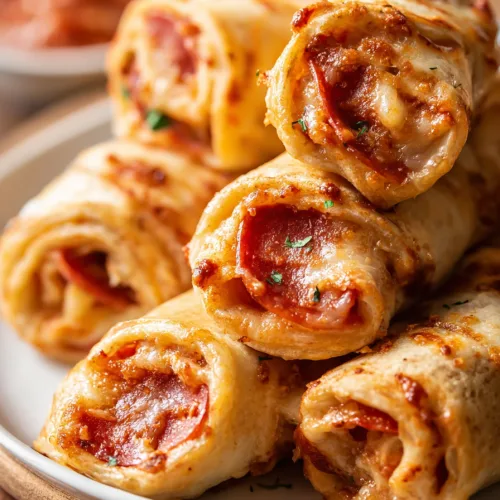
Easy Turkey Pepperoni Pizza Roll-Ups
Equipment
- 18×13-inch half sheet pan the four shells need at least 2 inches between them
- Parchment paper two sheets: one to line the pan, one as your assembly surface. Never wax paper.
- Medium Mixing Bowl
- Small offset spatula for spreading the shells and the filling evenly
Ingredients
- 2 cups low-moisture mozzarella cheese, shredded 8 oz / 226 g, DIVIDED: 1 3/4 cups (7 tablespoons per shell) baked into the four shells, and 1/4 cup folded into the filling. It has to be low-moisture shredded mozzarella. Fresh mozzarella packed in water releases far too much liquid to bake into a sheet that sets. This is double the mozzarella most versions of this recipe use, because here the cheese is not a filling component: it is the structure of the dish, and a thin shell tears when you roll it.
- 4 oz full-fat cream cheese, softened About 1/2 cup, half a standard 8 oz block, from a block rather than a tub and at true room temperature. Cold cream cheese will not beat smooth. All 4 oz goes into the filling. Once the marinara, mozzarella, basil and spices are folded in, the finished filling comes to about 1 cup, which divides into four portions of a scant 1/4 cup (about 3 3/4 tablespoons) each, one per roll-up.
- 8 slices halal-certified turkey pepperoni 2 slices per roll-up, about 13.6 g in total. Use thin deli slices: they roll far more neatly inside a thin cheese shell than thick-cut ones. Do not swap in a non-halal cured slice.
- 1/2 cup marinara sauce DIVIDED: 2 tablespoons beaten into the cream cheese so there is no free liquid inside the roll, and 6 tablespoons warmed and served alongside for dipping. Check the label and choose a marinara made without wine. Wine turns up in plenty of jarred tomato and tomato-basil sauces, and here 6 of the 8 tablespoons are warmed and served neat rather than cooked into the dish. A no-sugar-added sauce also meaningfully lowers the net carbs.
- 1 teaspoon dried oregano DIVIDED: 1/2 teaspoon into the filling, 1/2 teaspoon sprinkled over the shredded mozzarella before the shells bake. Crush it between your fingers to release the oils.
- 1 teaspoon garlic powder Into the filling. Use powder, not fresh minced garlic: fresh garlic adds water and loosens the filling.
- 1 tablespoon fresh basil, finely chopped Folded into the filling. Because the filled roll-ups are never re-baked, the basil stays raw, green and aromatic.
- 1/4 teaspoon freshly ground black pepper Into the filling.
- 1 pinch salt Or to taste, and taste the filling before adding any. The mozzarella and turkey pepperoni between them already contribute about 461 mg of sodium per roll-up, and the finished roll-up carries 695 mg with its dipping sauce. The nutrition figures assume no added salt; 1/4 teaspoon stirred into the filling would add roughly 145 mg per roll-up.
- 1 tablespoon fresh parsley, chopped Scattered over the finished roll-ups just before serving.
Instructions
- Heat the oven and set up. Heat the oven to 375°F (190°C) with a rack in the middle. Line an 18×13-inch half sheet pan with parchment paper – parchment, never wax paper. Tear off a second sheet of parchment and lay it on the counter as your assembly surface. Read the next two steps before you start: once the shells come out of the oven you have a two- to three-minute working window, and there is no time to go looking for anything.
- Make the filling. In a medium bowl, beat the softened cream cheese with 2 tablespoons of the marinara, 1/2 teaspoon of the oregano, the garlic powder and the black pepper until completely smooth and no orange streaks remain – you want the sauce emulsified into the cheese, not sitting on top of it. Fold in 1/4 cup of the shredded mozzarella and the chopped basil. Taste, then add a pinch of salt only if it needs it; the cheeses and turkey pepperoni are already salty. You will have about 1 cup of filling.
- Portion everything before the shells go in. Divide the filling into 4 equal mounds – a scant 1/4 cup, about 3 3/4 tablespoons each – on a plate. Separate the 8 turkey pepperoni slices into 4 pairs. Chop the parsley. Set the plate next to your sheet of counter parchment. This is the step that decides whether the last two shells crack, so do not skip ahead.
- Shape the shells. Divide the remaining 1 3/4 cups shredded mozzarella into 4 equal mounds of 7 tablespoons (a scant 1/2 cup) each on the lined pan, arranged two by two with at least 2 inches between them. Spread each mound into an even rectangle about 5 x 3 inches – deliberately smaller than the finished shell, because they spread as they melt and will come out at roughly 6 x 4 inches. Keep each one an unbroken single layer with no bare patches; any gap becomes a tear later. Sprinkle the remaining 1/2 teaspoon oregano evenly over the four rectangles.
- Bake the shells at 375°F for 12 to 14 minutes – start checking at 10, and let the cue decide rather than the clock. At 7 tablespoons of cheese each these sheets are far heavier than the thin rounds most cheese-shell recipes bake, and a heavier sheet needs longer to shed its water; 8 minutes leaves them wet in the middle, and a wet sheet never sets. They are ready when the bubbling in the center has stopped: the edges may still simmer faintly, but the middle should look still, matte and lacy with tiny pinholes rather than wet and glossy, and the edge should be a continuous deep gold the whole way round. Do not wait for the center to brown – a sheet browned in the middle has gone past pliable and will snap instead of bending. While they bake, warm the remaining 6 tablespoons of marinara for dipping (30-40 seconds in the microwave, or a minute in a small pan).
- Cool to the pliable window – on the pan. This is the step that makes the whole recipe work, and the hot pan is part of it: leave the parchment on it and do not slide the sheets onto the counter or a rack. The pan goes on driving moisture out of the underside for another minute or two and holds the cheese warm so the window stays open, where a cold surface chills the sheets from both sides and can take one from floppy to brittle in under a minute. Blot the pooled oil off the top with a paper towel – a 7-tablespoon sheet renders a lot of it, and oil left sitting there stops the seam gripping – then rest 2 minutes, 3 at the outside. Test one before you commit: push the edge with a thin spatula. It should slide across the parchment as a single piece, and the lifted edge should hold a curve without flopping or snapping – it feels like warm leather. If it stretches like the cheese on a hot pizza slice, or leaves a greasy film glued to the paper, it is underbaked: every sheet is underbaked together at this stage, so put the whole pan back in for 1 to 2 more minutes. If it clicks against the paper or cracks as you lift it, it has cooled too far. Work through them one at a time, in order, and expect the third or fourth to stiffen while you are filling the first two – that is normal, not a mistake. When one does, re-soften that single shell and nothing else: slide a thin spatula under it, lift it onto a square of parchment or foil set on a second pan, and give it 30 seconds in the oven on its own. Do not put the whole sheet pan back in – the shells you have not got to yet are still inside their window, and a second blast of heat would re-melt the ones that were perfectly fine.
- Fill. Spread one portion of filling over each shell in an even layer a scant 1/4 inch (about 5 mm) thick, taking it right out to within 1/4 inch of both long edges but leaving 1/2 inch bare at each short end. The filling itself is what seals this roll – cream cheese is the glue, exactly as it is in a tortilla pinwheel – so do not leave a wide bare strip along the edge you are rolling toward. The bare 1/2 inch at each end is there for the opposite reason: it gives the filling somewhere to go when you close the roll instead of squeezing out. Lay 2 slices of turkey pepperoni end to end over the filling along the near long edge.
- Roll. Starting from the turkey pepperoni edge, roll the shell away from you into a snug cylinder – snug enough that there is no hollow down the middle, but do not squeeze or compress it, or you will push filling out of both ends. Use the parchment underneath to lift and guide the roll while keeping the paper itself out of it. Finish with the seam underneath. Repeat with the remaining three shells to make 4 roll-ups total.
- Rest, then serve. Leave the roll-ups seam-side down for 3 minutes after the last one is rolled (the first ones will have had longer). They are ready when the outside feels firm and dry rather than greasy and the seam stays shut when you lift one. Do not return the filled roll-ups to the oven – the shells are already baked, and a second bake would only soften the cream cheese and let it run out the ends. Scatter the parsley over the top and serve them warm and whole, with the warmed marinara alongside for dipping. They are warm rather than hot: the shell still carries oven heat and the filling is at room temperature, which is as hot as this dish can safely get. Do not try to slice them at this stage – for a pinwheel platter, see the note on chilling.
Notes
Serving Suggestions
These turkey pepperoni pizza roll-ups are versatile, as long as you accept one rule: warm and whole, or cold and sliced, but not both at once. Served straight away they are a hand-held roll – pick one up, dip it in the warmed marinara, done. If you want a pinwheel platter instead, chill the finished roll-ups on their parchment for 15 minutes first, then cut each one crosswise into 3 with a thin, sharp knife, wiping the blade between cuts. That gives you 12 pieces and still 4 servings of 3. It adds 15 minutes to the total, and those pinwheels are eaten cold rather than warm.
For a more substantial meal I serve them alongside a crisp Caesar salad or some roasted vegetables – the richness of the cheese pairs beautifully with bitter greens like arugula or spinach. They make an excellent lunch too. If you like this format, my turkey roll-ups with pickles use the same idea with no cooking at all, and a low carb pizza bowl scratches exactly the same craving on a night when you do not feel like rolling anything.
Creative Variations
One of the things I love most about this method is how easily the filling adapts. The one rule that applies to every variation below: whatever you add has to be dry. A wet ingredient is the quickest way to a filling that runs and a shell that goes soft underneath it.
Mediterranean Style: Leave out the turkey pepperoni and fold 2 tablespoons of chopped pitted kalamata olives and 2 tablespoons of crumbled feta into the filling, with a teaspoon of chopped fresh oregano. Blot the olives dry on a paper towel first – anything wet loosens the filling and softens the shell underneath it.
Spicy Italian: Use spicy turkey pepperoni instead of plain, add 1/4 teaspoon of red pepper flakes to the filling, and serve with an arrabbiata-style marinara for dipping – check that label for wine as well.
Veggie Lovers: Skip the turkey pepperoni and fold in 2 tablespoons of finely chopped roasted red pepper and 2 tablespoons of sauteed mushrooms. Both have to be cooked down and blotted very dry, and keep the total addition to about 1/4 cup – a wet vegetable is the quickest way to a filling that runs.
Breakfast Version: Replace the turkey pepperoni with 2 slices of cooked, crumbled turkey bacon and fold a tablespoon of chopped chives into the filling. Good with the warmed marinara, or on its own.
Storage and Meal Prep
These keep in an airtight container in the refrigerator for up to 4 days. Eat them cold or at room temperature – they are genuinely good that way, and it is how I prefer leftovers. Do not reheat them. Warming a filled roll-up softens the shell and loosens the cream cheese, which is the exact failure this whole method exists to avoid, and the microwave is worse than the oven for it. If you want them warm, make them fresh.
I do not freeze them either, and I would not recommend it: the cream cheese filling turns grainy and weeps on thawing, and the baked shell goes soft. What does work ahead is the filling on its own. Mix it up to 3 days in advance, keep it covered in the fridge, and bring it back to room temperature before spreading. Then serving day is the 12- to 14-minute shell bake plus about 17 minutes of setup, shaping, filling and resting – call it about half an hour rather than the full 36 minutes, because mixing the filling ahead is the only step it takes off the clock.
Nutritional Benefits
This is a keto site, so here are actual numbers rather than adjectives. The figures below are per roll-up – one serving – and include that serving’s share of the warmed marinara dipping sauce. Percent Daily Values are based on a 2,000 calorie diet using the current FDA Daily Values.
| Nutrient | Per Roll-Up | % Daily Value |
|---|---|---|
| Calories | 297 | – |
| Total Fat | 22.3 g | 29% |
| Saturated Fat | 12.6 g | 63% |
| Cholesterol | 71 mg | 24% |
| Sodium | 695 mg | 30% |
| Total Carbohydrate | 7.7 g | 3% |
| Dietary Fiber | 0.8 g | 3% |
| Net Carbs | 6.9 g | – |
| Protein | 16.9 g | 34% |
Two things are worth saying plainly. The standout number here is the saturated fat at 63% of the Daily Value, not the sodium – and within the sodium, the mozzarella is doing almost all of the work: roughly 1,580 mg across the whole batch against about 265 mg from the 8 turkey pepperoni slices, close to six to one. Eight thin slices is under half of a single label serving, so the turkey pepperoni is genuinely not the culprit here.
Second, 6.9 g of net carbs per roll-up is on the high side if you are eating strictly. Skip the dipping sauce and it drops to 5.3 g, and a no-sugar-added marinara brings it down further still. For a lower-carb appetizer from the same melted-cheese family, my keto mozzarella sticks come in at 1.9 g net carbs.
These figures were calculated from USDA reference data for the quantities in the table above and are an estimate – your exact numbers will shift with the brands you buy. The turkey pepperoni line is based on generic national-brand nutrition panels rather than a halal-certified product, because no halal-certified brand publishes one, so treat that line as a stand-in. The nutrition assumes no added salt; a 1/4 teaspoon stirred into the filling would add roughly 145 mg of sodium per roll-up.
Frequently Asked Questions
Q: How do I prevent the roll-ups from falling apart? A: The old answer to this was to chill them, and chilling was never the fix. The structure comes from the mozzarella shell, which is baked and set before anything goes inside it. The one thing that decides whether they hold is the 2 to 3 minute cooling window on the hot pan – too early and the cheese is molten and unrollable, too late and it goes brittle and cracks. If a shell has gone brittle, lifting that one shell onto a second pan for 30 seconds in the oven softens it. And spread the filling right out to the edge you are rolling toward: the cream cheese is the glue that holds the seam shut.
Q: Can I make these ahead of time? A: The filling, yes – up to 3 days, covered, in the fridge, brought back to room temperature before you spread it. The shells, no. They harden and turn greasy as they sit, and the method depends on filling them inside the pliable window straight out of the oven. Bake and roll just before serving.
Q: Can I make these without baking them? A: No. The mozzarella shell is the structure, and it only exists because it is baked – there is nothing else in the recipe holding the roll together. But the filled roll-ups themselves never go back in the oven. The only bake here is the 12 to 14 minutes the plain cheese sheets spend on their own.
Q: Can I substitute the marinara sauce? A: Pesto works well, and so does a simple olive oil and herb mixture. Whatever you choose, keep it thick and use it sparingly inside the roll – a thin, watery sauce will loosen the filling. And read the label: some jarred pasta and cream sauces are made with wine.
Q: Is turkey pepperoni good in these, or should I use something else? A: Turkey pepperoni is what I build this recipe around, and it earns its place: it is leaner than most cured slices, so it does not flood a thin cheese shell with rendered fat, and its seasoning is doing the same job the crust seasoning does on a pizza. Buy it halal-certified, buy it thin-sliced, and lay the two slices end to end rather than overlapping so the roll stays an even thickness.
Final Thoughts
These turkey pepperoni pizza roll-ups have become one of my most requested recipes, and once the technique clicked I understood why. They satisfy that pizza craving in a little over half an hour, with an ingredient list you can read in one breath and nothing that needs proving, kneading or rolling out.
The best part is how customizable they are. Once you can feel that two-to-three-minute pliable window in the cheese, the filling is entirely yours to play with – that is the only skill in the whole recipe, and it takes exactly one batch to learn.
So do not stress if your first batch is not perfect. My first several were puddles, and the ones that tore still tasted excellent folded onto a plate. Happy cooking, and I hope these turkey pepperoni pizza roll-ups bring as much joy to your kitchen as they have to mine!
Keep cooking