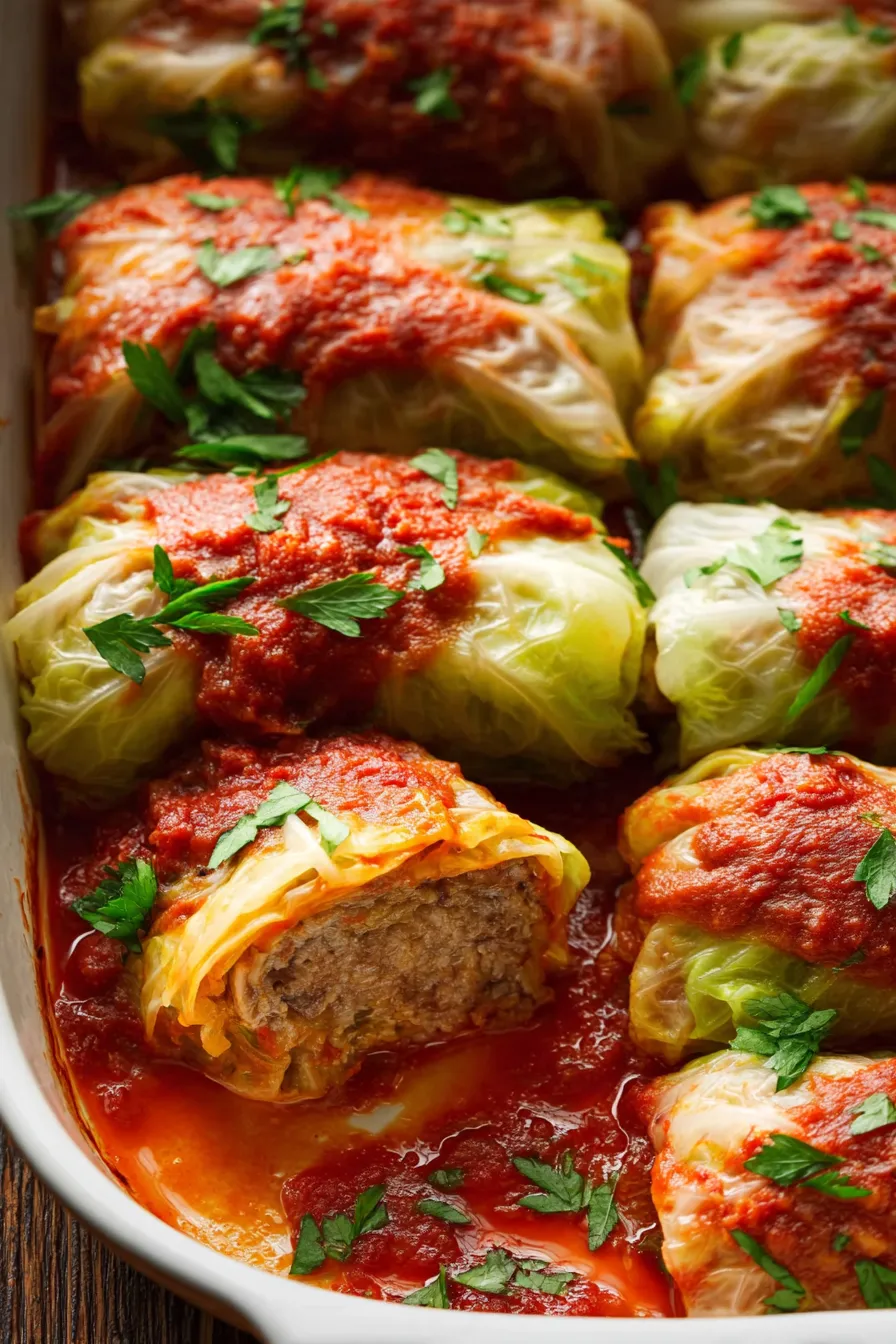
Keto Cabbage Rolls (No Rice, 8.6g Net Carbs)
- Total time
- 2 hours 10 minutes
- Makes
- 6 servings (2 rolls, about 125 g each)
- Net carbs
- 8.6g
- Calories
- 271
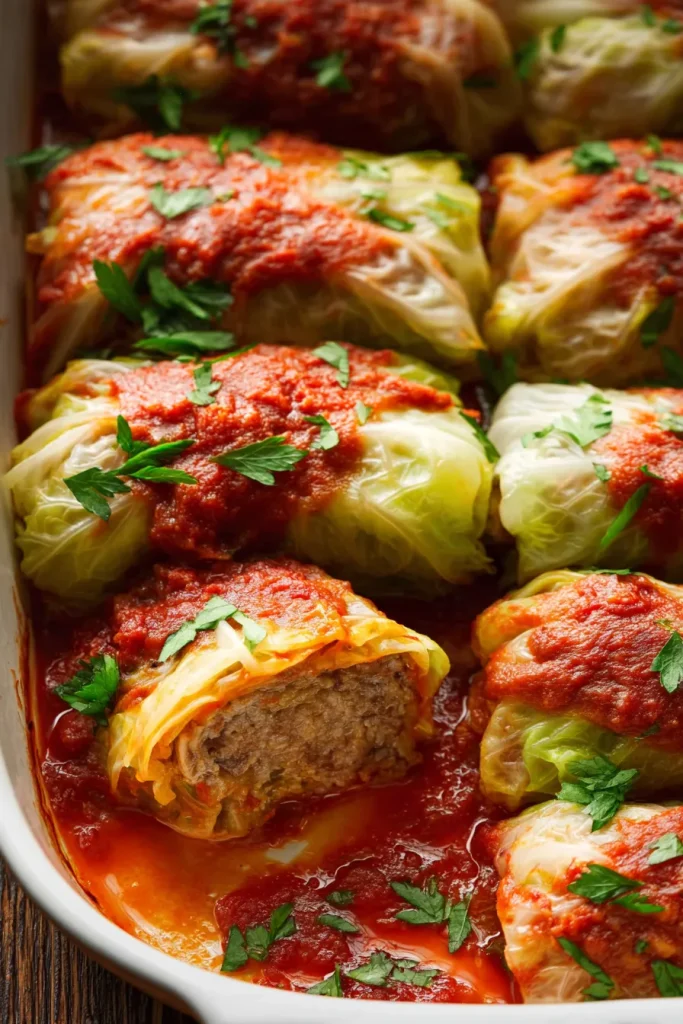
Take the rice out of a cabbage roll and you have not just removed a filler. You have removed the sponge.
In a traditional roll the raw rice sits in the meat and drinks up everything that leaks out of it over an hour in the oven. That is most of what it is doing. Every keto version swaps in cauliflower rice at one to one and calls it done — but cauliflower is about ninety-two percent water, so instead of a sponge you have installed a second source of liquid. That is why so many people open the foil and find soup with meat in it.
So this recipe does two things differently: the cauliflower is cooked and wrung out before it goes anywhere near the meat, and a small amount of almond flour and Parmesan goes in to do the job the rice used to.
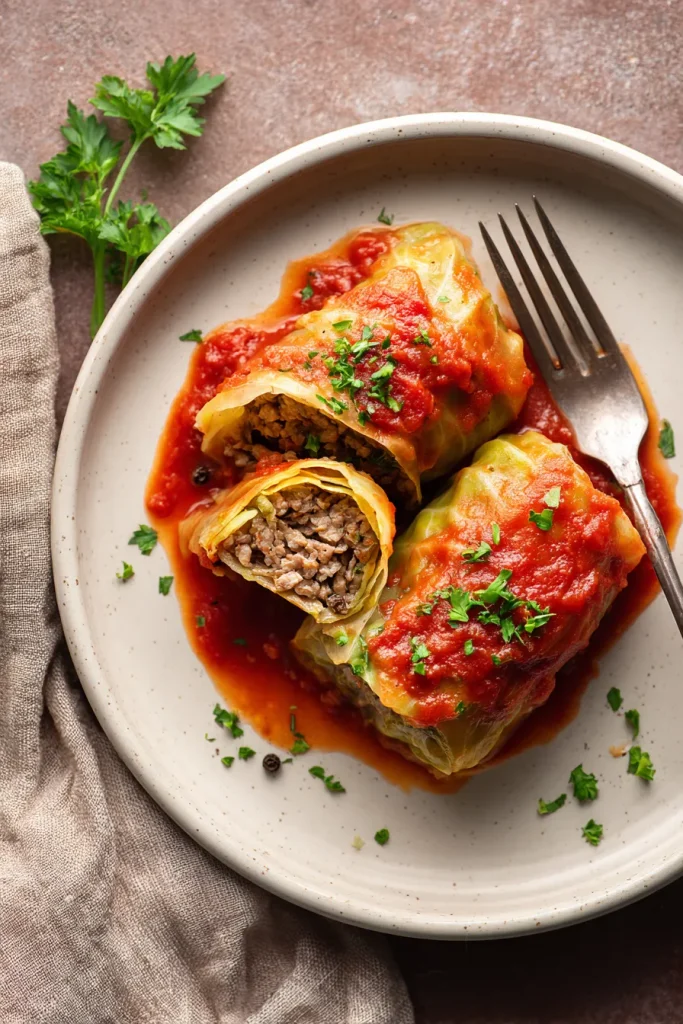
Getting the Leaves Off Without Tearing Them
Two methods work and I use both depending on how organised I am.
Boiling, same day. Drop the whole uncored head into a big pot of boiling water and give it 5 to 8 minutes. Lift it out, let it cool enough to handle, then flip it core-side up and cut each leaf free at the base rather than pulling it. Slide your fingers between the layers instead of peeling. When the inner leaves start resisting, put the head back in the water for two more minutes — keep the pot on the heat for exactly this reason.
Freezing, if you plan ahead. Core the head, wrap it, and freeze it solid for at least six hours. Thaw it overnight in the fridge and the leaves come away limp and intact with no boiling at all. It is more forgiving and it takes a day. Drain the thawed head well — freezing ruptures the cells, so it releases a surprising amount of water.
Either way, shave the thick rib flat or cut it out in a shallow V. A leaf with a full rib in it will not fold; it snaps along that ridge and spills.
Recipe Overview
- Prep Time: 40 minutes
- Cooling the cabbage: 15 minutes
- Cook Time: 1 hour 15 minutes
- Total Time: about 2 hours 10 minutes
- Servings: 6, two rolls each (about 250g)
- Net Carbs: 8.6g per serving
- Difficulty: Moderate — the rolling takes practice
Two hours is the honest figure, and most published cabbage roll recipes say ninety minutes by not counting the pot coming to a boil or the head cooling enough to touch. Those are twenty-five minutes you will actually spend.
Ingredients
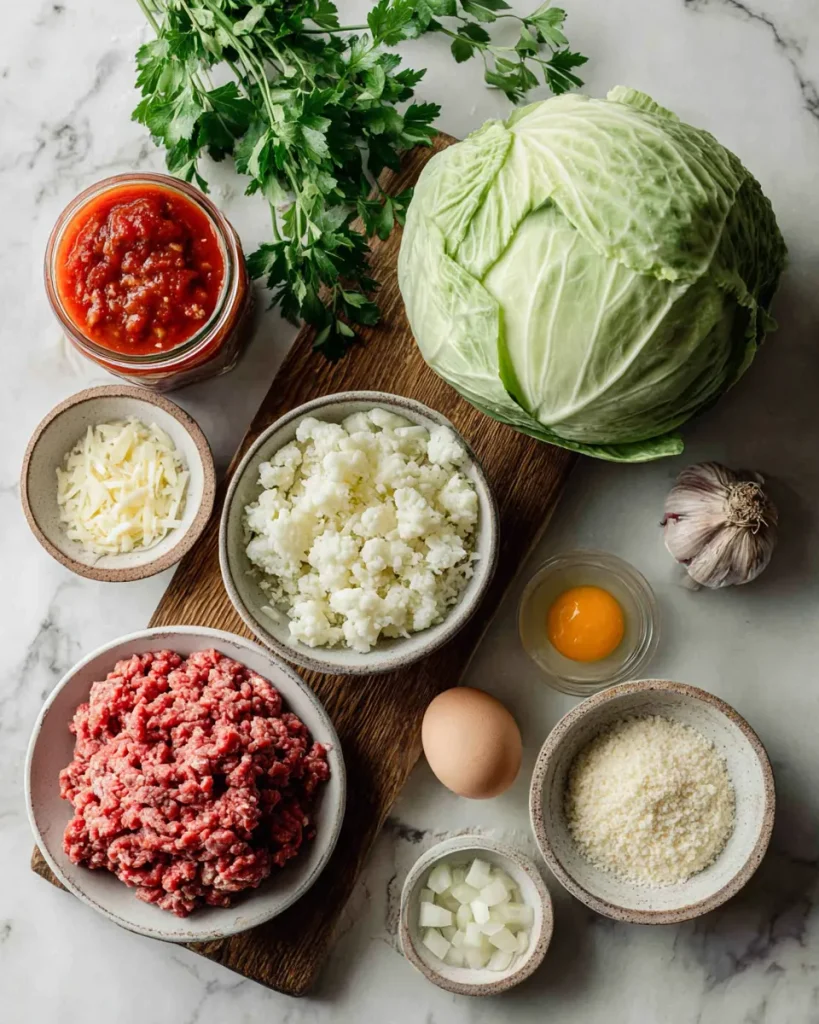
For the Rolls
| Ingredient | Quantity | Notes |
| Green cabbage | 1 large head, about 2½ lb (1.1 kg) | You will use roughly 550g of it — 12 leaves |
| Ground beef, 85/15 | 1 lb (450 g) | Leaner dries out inside the leaf |
| Cauliflower rice | 1½ cups raw (150 g) | Cooked and wrung dry — yields about 1 cup |
| Blanched almond flour | ¼ cup (28 g) | This is the sponge that replaces the rice |
| Parmesan, finely grated | 3 tbsp (15 g) | Absorbs, and seasons |
| Large egg | 1 | Binder |
| Onion, finely diced | 50 g (about ⅓ cup) | |
| Garlic, minced | 3 cloves | |
| Italian seasoning | 2 tsp | |
| Fine sea salt | 1 tsp | |
| Black pepper | ¼ tsp | |
| Fresh parsley, chopped | 2 tbsp |
For the Sauce
| Ingredient | Quantity | Notes |
| Tomato passata or plain tomato sauce | 15 oz (425 g) | No sugar added. Check the label |
| Apple cider vinegar | 1 tbsp | Lifts the tomato |
| Allulose or monk fruit sweetener | 1 tbsp | Balances the acidity, not for sweetness |
| Fine sea salt | ½ tsp |
A note on the cabbage weight. Most cabbage roll recipes say “one head” and leave it there, which is why their carb counts vary so wildly — cabbage is the biggest single carbohydrate in the dish and heads run from two to four pounds. The figure that matters is the roughly 550g of leaf you actually roll, not the weight of what you bought. That is what the nutrition below is costed on. Passata is the other variable worth knowing about: jars run from about 26 to 38 calories per 100g, which moves net carbs across a real 7.8g to 10.7g band. The figure below assumes a mid-range plain passata.
Recipe Timing
| Order | Step | Time |
| 1 | Bring a large pot to the boil | 10 minutes |
| 2 | Blanch the head, then cool it | 8 + 15 minutes |
| 3 | Cook and wring the cauliflower rice | 8 minutes |
| 4 | Peel, trim ribs, mix filling, roll twelve | 25 minutes |
| 5 | Bake covered, then uncovered | 60 + 15 minutes |
Step-by-Step Instructions
1. Blanch the cabbage
Bring a large pot of salted water to the boil — big enough that the head is fully submerged. Lower the whole uncored head in and boil 5 to 8 minutes, until the outer leaves are bright green and bend without cracking. Lift it out into a colander and leave it 15 minutes until you can handle it. Keep the water hot.
2. Cook the cauliflower rice, then wring it out
Cook the cauliflower rice in a dry pan over medium heat for 5 to 6 minutes, stirring, until it stops steaming. Tip it into a clean tea towel, let it cool a minute, and twist hard over the sink. You will be surprised how much comes out. What is left should feel almost dry and crumbly.
This is the step that decides whether you get rolls or soup, and it is not optional.
3. Peel and trim the leaves — then count them
Flip the cooled head core-side up. Cut each leaf free at the base with a paring knife and slide it off rather than pulling. Shave the thick rib flat with the knife held parallel to the leaf, or cut it out in a shallow V.
Count what you got before you portion the filling. This is the small thing nobody mentions and it saves the whole dish. A head gives you nine or ten good leaves and a few that tear, and if you have already committed to twelve equal portions you will end up overstuffing the survivors until they burst. Divide the filling by the number of usable leaves you actually have. If there is a surplus, spread it in a thin layer under the rolls — it cooks perfectly well and it protects the bottoms.
4. Mix the filling gently
Combine the beef, the wrung-out cauliflower, almond flour, Parmesan, egg, onion, garlic, Italian seasoning, salt, pepper and parsley. Mix until just combined and no further. Worked ground beef goes dense and springy, and inside a cabbage leaf that reads as rubbery.
Keep the bowl in the fridge while you roll if your kitchen is warm. Twelve rolls takes twenty minutes and this is raw beef with a raw egg in it.
5. Roll them
Stir the sauce ingredients together and spread half of it over the base of a 9×13 dish. Put a portion of filling near the stem end of a leaf, shape it into a log, fold the sides in and roll it up like a small burrito. Sit it seam side down in the dish. Pack them in snugly — they hold each other closed.
Pour the remaining sauce over the top.
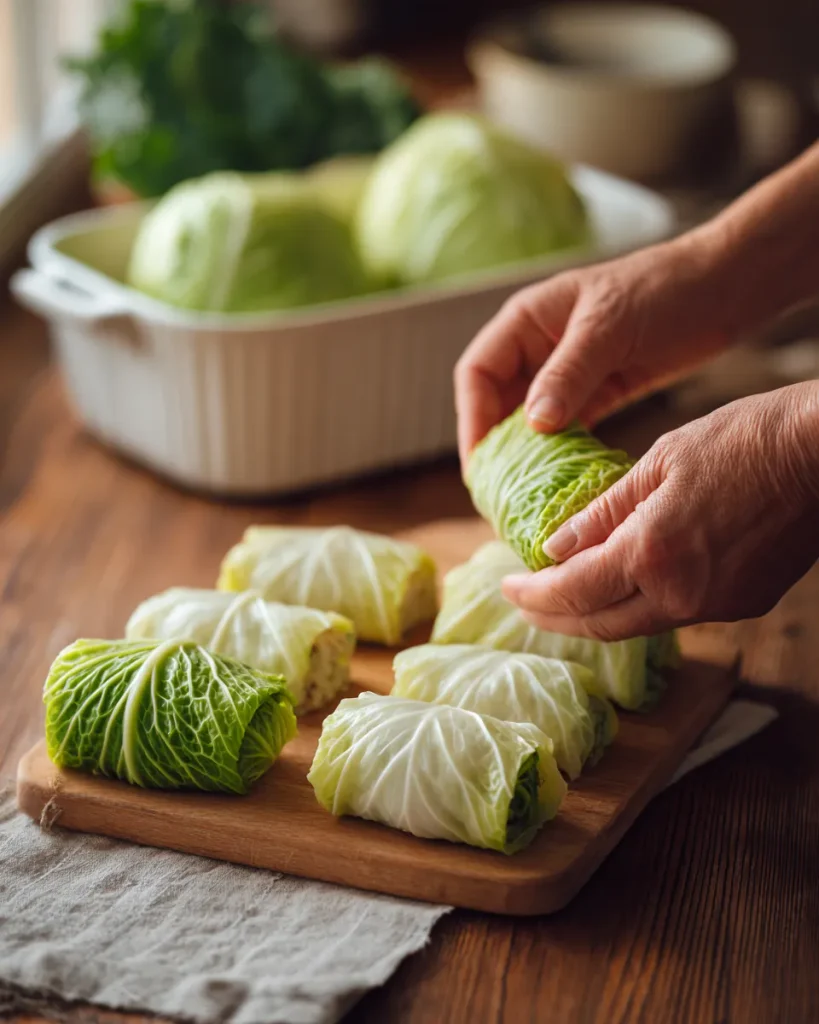
6. Bake covered, then uncovered
Heat the oven to 350°F. Cover the dish tightly with foil and bake 60 minutes, then take the foil off and give it 15 minutes more to thicken the sauce and colour the tops.
Check the middle of a roll with a thermometer: you want 160°F (71°C). Cabbage roll recipes almost never give a temperature and simply tell you to bake for an hour, which works for their leaf thickness and their filling size and may not work for yours. Ground beef needs 160°F because the surface bacteria get mixed all the way through when it is minced. If the leaves are still tough at temperature, cover it again and give it another fifteen minutes — the meat will not suffer.
Recipe Tips and Variations
About the almond flour. A quarter cup per pound of beef is my starting point and it is a judgement rather than a tested standard — no published recipe I could find installs an absorbent at all, so there is nothing to calibrate against. If the filling tastes heavy to you, drop it to 2 tablespoons next time and lean harder on wringing the cauliflower. If it is still loose, go to a third of a cup.
Ground turkey or chicken works, but they are much leaner and the filling dries. Add a tablespoon of olive oil to the mix and keep the covered bake to the full hour.
Savoy cabbage is easier to roll than green — the leaves are looser and more pliable straight off the head — but it is more delicate, so blanch it closer to 4 minutes.
Doubling means two dishes, not one deeper one. Stacked rolls trap steam, the bottom layer sits in liquid, and the timing goes out of the window.
Serving Suggestions
They need almost nothing. A dollop of sour cream, more parsley, and something green — roasted broccoli and cauliflower is what I usually make while they bake.
If you like this shape of dinner, low carb stuffed peppers use much the same filling logic, and keto stuffed pepper skillet gets you there in one pan on a weeknight.
Storage and Make-Ahead
Make ahead: assemble the whole dish, cover, and refrigerate up to 2 days before baking. From cold it needs about 15 minutes longer under the foil.
Fridge: 4 days. They are genuinely better on day two. Freezer: 3 months, baked or unbaked. Unbaked rolls freeze well wrapped individually; thaw overnight before baking.
Reheating: 350°F covered for 20 minutes, or a few minutes in the microwave with a spoonful of the sauce over the top so they do not dry out.
Frequently Asked Questions
Why is there liquid in the bottom of my dish?
Because the cauliflower went in wet, or the sauce volume was too high, or both. Cauliflower is over ninety percent water and it releases most of that under an hour of foil. Cook it and wring it in a towel first, and keep the sauce to about 15 ounces rather than adding broth or extra water on top of it. The final fifteen minutes uncovered helps at the margins, but it cannot rescue a genuinely wet filling.
My leaves keep tearing. What am I doing wrong?
Usually pulling instead of cutting. Turn the head core-side up and cut each leaf free at its base first, then slide your fingers between the layers to separate it. If the inner leaves resist, the head needs another couple of minutes in the hot water — the outer ones are always ready before the inner ones. And use the torn ones: two overlapped make a perfectly good wrapper.
Can I use raw cauliflower rice to save time?
You can, and this is the single most common reason keto cabbage rolls come out watery. Raw cauliflower has nowhere to put its water except into your dish. Cooking and wringing it takes eight minutes and it is the difference between a filling you can slice and one you spoon.
Do I have to brown the beef first?
No — it goes in raw and cooks inside the leaf, which is how traditional cabbage rolls are made and why the filling stays moist. Browning it first would dry it out and you would lose the juices into the pan instead of into the roll.
How many carbs are in keto cabbage rolls?
8.6g net carbs for two rolls, about 250g. Cabbage and tomato are most of it and neither is removable without losing the dish. Be careful comparing this against recipes that quote a lower figure without saying how much cabbage they used or how big a roll is — rolls in published recipes range from about 85g to 135g, which on its own is a fifty percent swing in the number.
More Keto Ground Beef Dinners
- Low Carb Stuffed Peppers — the same idea with a sturdier wrapper and no blanching.
- Keto Lasagna — for when you want the layers without the rolling.
- Keto Meatballs — the same seasoned beef, ready in 25 minutes.
- Easy Cabbage Soup — what to do with the rest of the head.
- Keto Turkey Meatloaf — another dish that lives or dies on its binder.
Recipe Card
If you have half a cabbage left over, my cabbage fritters with a garlicky dip is what I make with it — shredded, bound and fried in small rounds.
Half a head of cabbage left over? My keto coleslaw uses a pound and a half of it, shredded thin, salted for 30 minutes and squeezed dry so the dressing never waters down.
Keto Cabbage Rolls
Equipment
- Large stockpot big enough to submerge a whole cabbage
- Clean tea towel for wringing the cauliflower
- 9×13 baking dish
- Instant-read thermometer for the 160F check
Ingredients
For the Rolls
- 1 large head green cabbage about 2 1/2 lb / 1.1 kg; you will use roughly 550 g of leaf
- 1 lb ground beef 450 g, 85/15 – leaner dries out inside the leaf
- 1 1/2 cups cauliflower rice 150 g raw, cooked and wrung dry – yields about 1 cup
- 1/4 cup blanched almond flour 28 g – this is the sponge that replaces the rice
- 3 tbsp grated Parmesan cheese 15 g, finely grated
- 1 large egg
- 50 g onion about 1/3 cup, finely diced
- 3 cloves garlic minced
- 2 tsp Italian seasoning
- 1 tsp fine sea salt
- 1/4 tsp black pepper
- 2 tbsp fresh parsley chopped
For the Sauce
- 15 ounces tomato passata 425 g, or plain tomato sauce with no added sugar
- 1 tbsp apple cider vinegar
- 1 tbsp allulose or monk fruit sweetener balances the acidity rather than sweetening
- 1/2 tsp fine sea salt
Instructions
- Blanch the cabbage: bring a large pot of salted water to the boil, big enough to submerge the head. Lower the whole uncored head in and boil 5-8 minutes until the outer leaves are bright green and bend without cracking. Lift into a colander and cool 15 minutes. Keep the water hot – the inner leaves will want another two minutes later.
- Cook and wring the cauliflower: cook the cauliflower rice in a dry pan over medium heat 5-6 minutes until it stops steaming. Tip into a clean tea towel, cool a minute, and twist hard over the sink. What is left should feel almost dry. This step decides whether you get rolls or soup.
- Peel and trim, then count: flip the head core-side up, cut each leaf free at its base and slide it off rather than pulling. Shave the thick rib flat or cut it out in a shallow V, or the leaf will snap along it. Count your usable leaves BEFORE portioning the filling – a head gives nine or ten good ones and a few tears, and committing to twelve portions first is how rolls end up overstuffed and burst.
- Mix the filling: combine the beef, wrung-out cauliflower, almond flour, Parmesan, egg, onion, garlic, Italian seasoning, salt, pepper and parsley. Mix until just combined and no further – worked ground beef goes dense and rubbery. Keep the bowl chilled while you roll.
- Roll: stir the sauce ingredients together and spread half over the base of a 9×13 dish. Put a portion of filling near the stem end of a leaf, shape it into a log, fold the sides in and roll it up. Sit each seam side down, packed snugly so they hold each other closed. Any surplus filling goes in a thin layer underneath. Pour the remaining sauce over.
- Bake: 350°F, covered tightly with foil, for 60 minutes. Uncover and give it 15 minutes more to thicken the sauce and colour the tops. Check the middle of a roll with a thermometer – you want 160°F (71°C), because ground beef has its surface bacteria mixed all the way through. If the leaves are still tough at temperature, cover and give it another 15 minutes.
Notes
Keep cooking